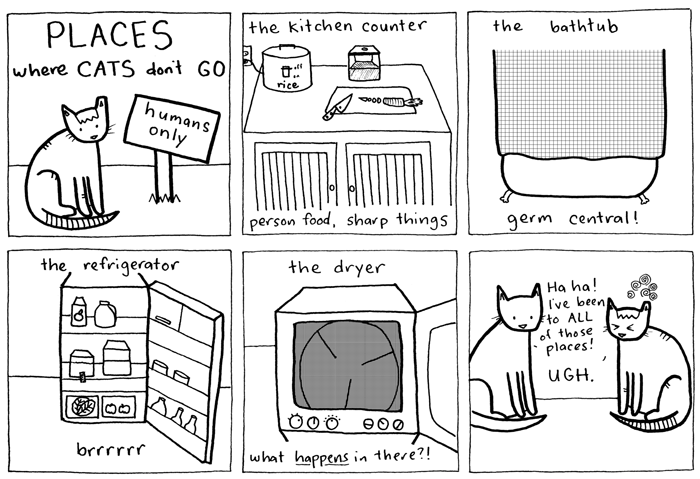
Tuesday, May 27, 2014

Webcomic Worth Wreading, Entry 40: Saturday Morning Breakfast Cereal

When confronted with something so totally outside the social norms that there is no way to determine an appropriate response, a human will often resort to laughter. Shock humor exists entirely because of this phenomenon. Overall, I’m not a fan. Making audiences uncomfortable through use of profanity and/or taboo subject matter may get you laughter, but it doesn’t give your jokes any substance.

There are, however, a handful of artists who do both. Their work combines shock value with observations on human nature, irrational actions taken to absurd extremes, or old ideas presented in new and unexpected ways. Today we’ll look at a webcomic that does all of this and more, walking the line between crude and pretentious as few others can. I present to you: Saturday Morning Breakfast Cereal.
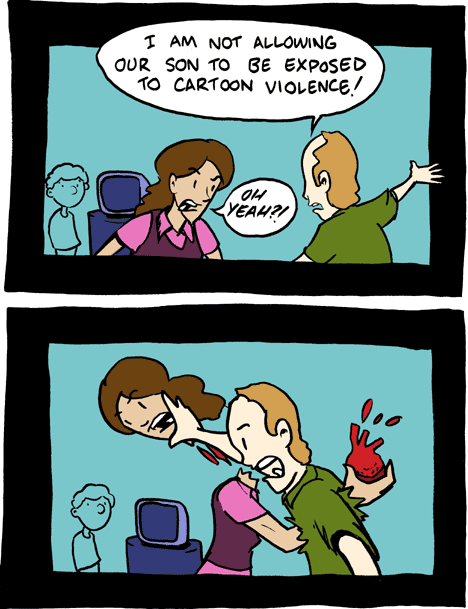

Saturday Morning Breakfast Cereal is a gag-a-day comic that is at turns delightfully irreverent, heartwarming, cynical and philosophical. Each installment stands on its own, entirely disconnected from whatever came before or since. There’s no need to read them in order, no spoilers or recurring characters to worry about. Feel free to jump in at any point in the archive, to read them all in chronological or reverse-chronological order, or to just hit the “random” button a few times and see what you get.

Certain visual shorthands are used multiple times, such as the representation of god as a sort of shining golden disc, but it’s always easy enough to understand what’s going on.

I certainly won’t discourage binge-reading, because there’s a lot of great material in that archive, but that’s not necessarily the best way to enjoy this comic. Don’t feel pressured to get through all 3,000-plus pages. Just browse awhile and enjoy what you see.


A lot of the jokes are simple, relying on literal interpretations of speech or just presenting a reversal of what’s expected in a given situation. Many installments are single panels, which aren’t actually comics according the McCloudian definition but, hey, I’m here to talk about the stuff I like, not quibble over terminology.

One hallmark of Saturday Morning Breakfast Cereal is a reversal in tone, taking something apparently innocent and making it depraved, or something apparently horrific and presenting it as innocent. Sometimes these switches will pile up, as the scenario switches back and forth between comfortable and terrifying until the audience doesn’t know which way’s up anymore.


This is a comic with no limits. Any subject matter is on the table, from base observational humor or discussions of advanced mathematical theorems. Highbrow and lowbrow subjects often mix, leading to crude jokes about sophisticated subjects or apparently sophisticated setups that lead up to an inevitable joke about penises. Sometimes the humor lies in these unexpected juxtapositions of subject matter, but often that’s just the starting point. Dismiss closely held ideals, take ridiculous notions seriously, and treat the world as a breeding ground for absurdity, and you’ll begin to understand this comic’s sense of logic.

One of the best examples of Saturday Morning Breakfast Cereal’s peculiar composition of usually disconnected elements can be found below, where a pair engage in a classic comedy routine with a twist.

It's too big to embed it all here, but click through and read the whole thing. It's worth it.

The thing that I love most about Saturday Morning Breakfast Cereal is its political conscience. That’s an odd thing to say about such an irreverent and crude comic, but I find that it promotes a worldview I believe in, one of acceptance and cooperation, quite consistently. A handful of installments are overtly political or satirical (see this, and this), but what I appreciate more are the subtle ways that the comic consistently reinforces an open and egalitarian viewpoint without overtly stating it every time.

When the race or sex of a character is not relevant to the joke, that character may have any of a wide range of appearances. Women and people of color are shown in positions of power, because there’s no reason for them not to be. Same-sex couples show up even when the joke doesn’t specifically require a same-sex couple in order to make sense.

In Saturday Morning Breakfast Cereal, straight white and male is not the default setting from which all other humans deviate. I wish more media represented this kind of diversity on a regular basis, so I like to acknowledge it when I do see it with the hope that others will start picking up on the idea.

In similar circumstances, I honestly don't think I'd do any better than this guy.

One thing you should be aware of is the red button below each comic. Click on it for a bonus! The earliest installments don’t have anything, the first one being here, but it works for almost all of them after that point. Usually it’s just a little added joke, but sometimes it really makes the comic seem worthwhile to me. For instance, I wouldn’t be nearly as fond of this one:


If it didn’t include this:


Read Saturday Morning Breakfast Cereal and enjoy a wealth of humor, some of which will make you feel like a better person, and much of which will make you feel like a significantly worse person. I feel like there’s something there for almost everyone, given the breadth of subject matter and the extensive archive. If you like to look at the world critically without taking much of anything seriously, then Saturday Morning Breakfast Cereal is for you.


Saturday Morning Breakfast Cereal is written and drawn by Zach Weinersmith (né Weiner) and updates every single goddamn day, pretty much. I recommend it to people who are looking for a quick laugh but who secretly want to get sucked into a debate about a philosophical conundrum. By which I mean, humans are weird and I invite you to go laugh at some.


Next Entry: Drive

Tuesday, May 13, 2014

Webcomic Worth Wreading, Entry 39: Chainsawsuit

As I curate this blog, at times I have to balance conflicting desires. One such conflict follows: I want to represent a wide swath of webcomics, showing off a diverse selection of creators, genres, and styles. But I, though an avid reader, have only encountered a small portion of what’s out there, and furthermore, my own tastes tend to limit my range of appreciation. For instance, I am more likely to discuss science fiction than other genres, because I tend to like it more.

And, while I would love each post to highlight the work of a different creator than all other posts, there are some creators whose work particularly resonates with me. When these creators have multiple comics to their names, I’m left with a dilemma regarding which comic to discuss, or whether to dedicate multiple posts to the same creator.

With Jeffrey Rowland, I solved the problem by discussing all of his comics in one post. I mostly ignored this problem when I got around to Not Invented Here, because the team behind that comic is unique, even if certain creators worked on other comics that I had already discussed.

Today, I’m revisiting a creator whose work has been featured on this blog in the past. Kris Straub’s Broodhollow is haunting and beautiful, a carefully crafted tale of horror wherein the depth of the story is perfectly complemented by its humor. There is no way that I could thoroughly discuss a gag-a-day comic, with little continuity and less consistency in logic, in the same post as Broodhollow and maintain any sort of coherence. So here I am, on a new day with a fresh post, to tell you all about Chainsawsuit.


Chainsawsuit typically presents quick, simple jokes, using running gags, absurdity, exaggeration, or whatever other techniques are required to make a joke work. The three-panel format is almost incontrovertible; nearly every Chainsawsuit installment fits into this exact shape, though a handful will add a second row for a total of six panels. This is ephemeral humor; usually providing a brief escapism into this comical world before one moves on to either reality or the next source of escape. Even so, there are a handful of Chainsawsuit jokes that really stick with me, that I think back to months or years after reading them and still crack a smile.


The ephemeral nature of Chainsawsuit is reflected in the website design. There’s no easy way to navigate to the first comic, discouraging readers from going through the whole archive at once. Almost every installment works perfectly well in isolation without having read anything leading up to it. If a reader desires, it’s entirely possible to read the whole archive in reverse-chronological order by repeatedly clicking the arrow for the previous comic. Or, you can just let me link you to the first comic and read from there. It’s not by any means required, though, and Chainsawsuit is a rare case where I’d argue that jumping in and not worrying about the archive or catching up is a superior experience to reading everything from the beginning. If you do enjoy archive-bingeing, you can see the first appearances of various recurring characters, as well as the origin of the title.

Otherwise, just go ahead and start reading anywhere. There’s even a random button if you’d like to skip around. Everything should make approximately the same amount of sense whether you’ve read the whole Chainsawsuit archive or not.


Subject matter ranges from incidental to philosophical, working in critiques of media or society, commentary on current events, or just silly ideas that don’t seem related to anything outside the author’s singular imagination. Every Chainsawsuit installment is an individual piece, sometimes with a completely dissimilar tone from every other Chainsawsuit installment. There’s an incredible variety to this comic. I definitely recommend browsing through it a little; even if the first few examples you come across don’t strike your fancy, there may be one just around the corner that makes you laugh like a toddler who’s encountered a puppet. At least, that’s the way my experience tends to run.

Occasionally the humor veers toward topical subjects. I always hesitate to use topical comics as examples in this blog, because there’s no guarantee that other people will remember or care about a past event enough to enjoy a joke about it. The following one, however, struck me as funny enough that I would be derelict in my duties as a blogger if I did not share it with you.

To my knowledge, Hulu never did wind up pushing this change.

Chainsawsuit displays a carefully cultivated level of crudity, both in art style and subject matter. This comic has never encountered the concept of formality, frowns on the use of capital letters, and revels in irreverence. For all that, there’s surprisingly little recourse to shock humor. The occasional provocative joke comes off more as charmingly naive than devious or underhanded, though clearly the author knows exactly what he’s doing. For this style of humor, crudity works. Visual complexity would dilute the jokes, and tact requires extra space without adding to comedic value.

This is not a comic I’d recommend to the easily offended, but at the same time it’s not a comic that I’d describe as offensive. It’s more the type of comic that marketers would want to label as offensive in order to make it seem edgier, because the number of people who’ll refuse to read it is smaller than the number of people who’ll be more interested in something that’s too real for the mainstream.

Really, though, it’s just a matter of presenting simple ideas in as clear and funny a way as possible. Most of the time there’s nothing directly challenging cultural sensibilities; it’s more that cultural sensibilities are not directly relevant to making something funny.


The format, oppressive though it may seem, allows for a great deal of variety in execution. Chainsawsuit often uses text to label or narrate significant aspects of the comic, allowing for more information than can easily be communicated in three simple drawings. Often the images are secondary to the text, sometimes entirely unnecessary to understand the joke, and on rare occasions the comic will consist of nothing (or nearly so) but text.

Sometimes, though, very little text is needed to get the point across.


Chainsawsuit is a wonderfully varied source of simple humor. There are twists on old jokes, plays on modern trends, and just plain absurd fun. Rarely have I found such good-hearted joviality in such close proximity to hardened cynicism. You never quite know what you’re gonna get, so just be prepared for anything.

Or, maybe don’t try to prepare, because being taken by surprise is half the fun.


Chainsawsuit is written and drawn by Kris Straub and updates more or less consistently on weekdays. I recommend it to casual readers looking for a quick laugh. That’s right. Go ahead, laugh. Casually. And be quick about it.


Tuesday, April 29, 2014

Webcomic Worth Wreading, Entry 38: Hey Pais

Journal comics! There are a lot of them out there. When done well, a journal comic can highlight familiar experiences or give expression to something that the reader understands but has never thought to elucidate. The author may find the humor in everyday life, prompting the audience to delight in otherwise mundane tasks, or just to feel a sense of camaraderie, knowing that other people share those experiences, even if few ever voice them.

Another use of journal comics can be to illustrate the experiences of someone who shares little with the audience. Little-understood cultures or professions may be illuminated, helping the world to become more connected through the art of self-expression.

Today we’ll be talking about a journal comic that achieves the latter, by illustrating the experiences of someone who is not even human. Welcome to the world’s only journal comic written and drawn by a real-life cat: Hey Pais.


Hey Pais lets us in on the daily life of an ordinary the prettiest cat, Pais (short for Paisley). She keeps us up to date on the goings-on of her catnip mice, the humans she lives with, and important news of the feline world. It’s a pretty simple premise, but it’s tackled with a level of dedication and sincerity (of a sort) that make it engaging.


Humans who’ve lived with cats before will find some familiarity in these comics. Pais behaves in many ways as other cats do, prompting us humans to shrug and laugh and chalk up the behavior to just more crazy cat antics. By reading Hey Pais, we humans can gain some insight into a cat’s perspective on these antics. Pais understands her own behavior, and she lays it out in such a way that it’s obvious why she behaves the way she does. It’s taken for granted that this behavior makes sense; the assumptions tend to go unstated, but it’s easy to tell what it is we are meant to be assuming.


Sometimes Hey Pais provides cool cat facts! These tidbits are useful for cat owners, and fascinating for those out there who don’t have direct experience with cats. Some of the cat stereotypes you’ve likely heard are incorrect, or self-contradictory. Hey Pais does its part to spread understanding and awareness.


Not all cats are alike. Hey Pais provides one cat’s perspective, and as any cat owner is aware, every single cat is a precious snowflake with notable distinctions separating him or her from every other cat in appearance and personality.

Each author can only truly trust themselves to represent their own perspective. Empathising with others is a useful quality, but it can be difficult to truly put yourself in another person’s mindset, especially if your own life experience is somewhat limited. Pais spends most of her life in the same home, seeing a limited handful of people, and encounters few things that challenge her worldview.

When a second cat moves in, we get a useful shaking-up of the status quo, and get to see first-hand some of the ways that Pais’ experiences of normality do not necessarily extend to all cats.

(The arrival of the boy cat Boo Radley would be a spoiler, but since this is a journal comic depicting things that happened in real life, the application of the concept of spoilers doesn’t make sense.)


If you read Hey Pais, you’ll get to learn more about what it’s like to be a cat, through one individual cat’s perspective on the world around her. There are recognizable behaviors, the kind that spark a feeling of amused familiarity, along with some unique tendencies that are all Pais. It’s a lighthearted and fun way to get a feeling of a completely different perspective to the one you’re used to, i.e., that of a human.

So if you like cats, or you just feel like expanding your narrow personal horizons a little bit by empathizing with a member of a different species, check it out!


Hey Pais is written and drawn by Sara Bauer Paisley Paiserton and updates irregularly. I like to check back every month or so and see if there’s anything new.

You don’t have to read Hey Pais in order, though there are some recurring terms that make more sense if you read the comics where they’re first introduced. For example, above, “loafhacker” is a pun on “lifehacker” (which you probably got) and the term “loafing” for the way that cats lie around the house (which you may not have realized). Plus, the archive is a pretty quick read, so if you’re in the mood to read the whole thing I’d recommend it. Mostly, though, it’s easy to catch on so if you’d rather just jump in with any old comic feel free.


Next Entry: Chainsawsuit

Wednesday, April 23, 2014

A Year In

Today marks one year since the first Webcomics Worth Wreading entry went up. Let's take a look at the first year of this blog's existence.

Featured Webcomics: 37

If I'd kept up with the weekly schedule I started with, that number would've been 52. But real life showed up and I missed a week here and there before switching to a biweekly schedule. I'm using biweekly to mean "every other week" instead of "twice a week." I hope that was clear.

Doing this every other week has been much more manageable, although I did wind up skipping one of the dates when I would have otherwise posted, even by this more lenient schedule. But I used that time well, and even spent some of it reading comics that I hadn't dived into previously. March was an awfully full month for me, and I'm glad some of it was filled with reading. The future of this blog depends on me continuing to expand my reference base.

Books I've been quoted on: 1

Spacetrawler has now concluded, and the third and final volume has been printed. There is a quote from my entry about Spacetrawler on the back of the book. I'm pretty happy about that.

Most popular blog entry: Oglaf (Be warned that that particular entry is NSFW.)

The majority of traffic this blog gets is from people looking for Oglaf. (Since the entry on this blog regarding that comic is NSFW, it's a fair bet that the comic itself is NSFW also, but I figure I'll state it outright just in case.) The Oglaf entry hasn't quite been viewed more times than every other entry on this blog combined, but it has been viewed an awful lot.

I guess the lesson here is that people on the Internet like porn, which is not actually all that surprising.

Webcomics that have been recommended to me since I started: Loads.

Starting years ago, I started bookmarking webcomics that people had recommended, on Twitter or on their own websites or wherever. Sometimes I would read one of these comics immediately, but sometimes I didn't have the time, or I wasn't in the mood to explore something new, and I would bookmark it. I now have a massive bookmark folder full of recommendations. They've been accumulating for a long time!

Ideally, I would read these comics at some sort of steady rate, but I haven't developed any sort of system to go through them all, so I get around to them haphazardly and unreliably. And after I started doing this blog, people started telling me about lots and lots of different webcomics that they think I should look at.

I don't want to discourage recommendations. I like hearing about new webcomics. I like reading new webcomics. I will cheerfully add new bookmarks to my already-huge folder of webcomics that I haven't yet read but that I want to try. But I might not get around to reading new recommendations for a while.

That reading I did in March? Part of that time was spent digging into that oversized bookmarks folder. I actually made a dent in it. I'm pretty happy about that.

Amount of frustration I've had with Blogger's formatting capabilities: SO MUCH

When I launched Webcomics Worth Wreading I didn't know very much about Blogger. I was learning as I went. One of the things I learned early on is that placing images where I want them to be in blog posts and making sure they're the size I want them to be is somewhat tricky. Even trickier, though, is trying to convince Blogger to insert the correct number of line breaks in my post. I don't know why, but fairly often when I hit preview there are a bunch of extra line breaks. It takes some time to wrangle each post into looking roughly the way I want it to.

Then, there are instances where some paragraphs are clearly single-spaced and others use 1.5 spacing and I can't tell what's different about them that makes the spacing change between paragraphs. It's a mystery to me.

Honestly, there are lots of small formatting adjustments that I would love to make to this blog, but after all the big formatting adjustments I have to do for each post, I never have the energy.

People I have to thank: SO MANY

All of the creators whose comics I have written about. The people who've commented on this blog, or to me on Twitter. Gary Tyrell of Fleen for being an early supporter. Scott McCloud for basically teaching me that comics are a thing and for creating or introducing me to the first webcomics that I read. People who've provided me encouragement in real life.

All of you have helped me to keep this blog going. I've enjoyed writing it for the past year, and I hope you've enjoyed reading it, too.

The future: Bright

There are still lots of webcomics that I'm eager to write about. I should definitely be able to keep this blog going for another year. And, if people keep creating new things and I keep reading them, then theoretically I should be able to keep this blog going indefinitely.

Until such a time as indefinitely comes, I'll be here.

Thanks for letting me talk at you. There'll be a proper entry up next Tuesday.

Tuesday, April 15, 2014

Webcomic Worth Wreading, Entry 37: Axe Cop

Today’s entry is all about fun. It’s a particular kind of fun, too; the kind of fun that involves crazy weapons and ever more creative ways to kill your enemies. The kind of fun where the good guys always win, but there are always more bad guys to fight even though I could swear we’ve killed every bad guy in the world several times now.

It’s the kind of fun you’re in for when you start to read Axe Cop.

You may notice that Flute Cop is holding a recorder, not a flute. You may notice a lot of things. I encourage you to just roll with it.

Axe Cop is a story about a cop who has an axe. He uses his axe to kill bad guys.

It’s a simplistic premise, but things get wicked complicated. Axe Cop’s best friend and partner is Flute Cop, who sometimes turns into Dinosaur Soldier, or Avocado Soldier, or, as seen above, Ghost Cop. A whole host of other characters show up as good guys who ally with Axe Cop or as bad guys who fight him. The world operates according to its own surreal logic that bears little to no connection to reality. (Getting blood on you turns you into the kind of thing that the blood belonged to! I mean, obviously.)

I’ll note here that I’m not going to worry the slightest bit about spoilers for Axe Cop. The joy of reading Axe Cop is in the concepts, the big ideas and the little quirks that make this a piece of entertainment like no other. The plot itself is secondary, and is best enjoyed as it comes rather than dissected and anticipated. We’re not here for intricate plot twists. We’re here to see some good guys using their awesome weapons to fight bad guys.

Axe Cop has lobster antennae at this point in the story. Again, just roll with it.

The origin of Axe Cop in the real world is that a five-year-old kid describes what happens in the story, which is then drawn by his twenty-nine-year-old brother. Axe Cop has been running for a while now, and the kid who generates the ideas is now ten, but it still works the same way, and, importantly, it still has the same feel.

This is a child’s imagination game laid out on paper, and it is magnificent. (I guess it’s not so much laid out on paper as rendered on a screen, but that just doesn’t sound as impressive.) The stakes are high, the morality is black and white, the good guys always win, and this comic constantly surprises me. One thing that I’m constantly looking for in media is an idea that I would not have been able to come up with on my own. Axe Cop usually delivers several of them per page.


Sometimes the events in Axe Cop don’t feel like a story I’m reading so much as like a dream I’m having. There’s that free association of ideas that comes when you’re just listening to pure creativity without self-editing. Absurd things happen and then the justification comes later, or there’s no justification at all. It’s freeform storytelling of the kind that can only happen when no one is listening to the rules that usually keep stories in order. In Axe Cop, the rules are flexible. Unless you are a bad guy. If you are a bad guy, Axe Cop will show you no mercy.


As you may expect, with a story written by a child, there is very little artifice, no apparent agenda to the storytelling, and never a hint of a moral. Axe Cop is pure entertainment, unadulterated (such an appropriate word) by any sense of what stories or media should be telling the audience.

The reader gets a very clear sense of Axe Cop’s authorship. This comic is a little boy’s wonderland. There’s fighting and giant robots and zombies and the good guys just want to kill all the bad guys and I’m not really sure what most of the bad guys’ motivations are but that doesn’t really matter because they’re bad guys. Reading Axe Cop is a refreshingly pure experience, taking a step away from all the subtle commentary and allegory that can be found in almost all fiction.

While there’s no obvious intention for this comic to rise up and fight the status quo, we do get to see a child’s perception of the way the world does or should work, and that perception turns out to be slightly different from the cultural expectation. It’s fascinating, and potentially troubling, if you think through the full implications, but it’s definitely a different direction than the one we’ve come from. This is a snapshot of the cultural milieu through the filter of a child’s imagination and I don’t want to read too much into it but if I did want to, I absolutely could.


Figuring out where to begin can be a challenge. Well, I’m here to tell you that if you’ve never read Axe Cop before, the place to start is here. Read the first four pages, and then read this one. And then just keep going.

Of course, once you get into the story, things are further complicated because the main comic runs concurrently with a segment called Ask Axe Cop, which is in a different section of the archive. Stuff that’s established in Ask Axe Cop frequently shows up in the main comic, so it’s a good idea to try to read both of them at the same time, but it can be tricky figuring out when you should read each Ask Axe Cop with reference to where you are in the main archive. I recommend just reading the main story until you reach a footnote directing you to Ask Axe Cop, and then reading a bunch of Ask Axe Cop until you’ve read the one that the footnote was talking about.

There’s a third set of comics, called Axe Cop Presents, which can be read whenever you want because it doesn’t affect the Axe Cop continuity. Axe Cop doesn’t appear in those comics, but they definitely have the same feel to them, so if you enjoy Axe Cop, you should definitely check them out.

There are two Axe Cop stories that have only appeared in print, “Bad Guy Earth” and “President of the World.” Events from those stories are mentioned in the online comic, but remember how I said I wasn’t going to worry about spoilers? The same principle applies here. Feel free to read everything that’s online and any time something comes up that was introduced in a print comic, just roll with it. Accept the new information and move on. Then, someday, when you get a chance to read the print comics, I recommend you do so because they’re great. Just don’t let them hold you back from reading what’s immediately available. Don’t let some minor confusion or even a handful of continuity errors ruin your fun. The way to enjoy Axe Cop is to accept things as they come.

Axe Cop is dressed as a cat here. Roll with it.

I find that Axe Cop is a great comic to read with children, because it’s fascinating and imaginative and probably about as edgy as I would want children’s entertainment to get. Being written by a kid indicates that the content is probably going to be safe for most kids to handle, though that does depend somewhat on parental rules regarding exposure to violent content. That’s a judgement call that each family makes differently, and while I wouldn’t think that the type of violence in Axe Cop would be harmful to a developing psyche, I understand that others may have different attitudes. When I was in preschool I thought Power Rangers was the greatest thing ever created, and one of my friends wasn’t allowed to watch it, and I thought her parents were just insane or horribly cruel, but now I can kind of see where they were coming from, you know?

If you’re an adult, Axe Cop is tremendously fun. If you’re a kid, bug your parents to let you read Axe Cop, which shouldn’t be too hard because if you’re a kid and you’re reading my blog I’m guessing your parents let you read a lot of stuff. If you’re an adult who has kids in your life, introducing them to Axe Cop is a move that I would wholly endorse. This comic is a peculiar kind of wonderful, and everyone should have the opportunity to enjoy it.


Axe Cop is written by Malachai Nicolle and drawn by Ethan Nicolle. Color, in the recent stories, is provided by Kailey Frizzell. The currently-running main story is a guest arc written by Charlotte and Amelia O’Brien and drawn by Tom Martin. Watch for mouseover text starting about here for the main comic and here for Ask Axe Cop.

I recommend Axe Cop to anyone who has ever enjoyed an action movie, or to anyone who think that maybe they would enjoy action movies if they weren’t all so darn serious. If you have any sense of fun at all, you really should give Axe Cop a try. It’s one of the most fun things I’ve ever encountered on the Internet, and there isn’t anything else quite like it. Go forth, and read about Earth-shattering events never encountered anywhere before or since.