Tuesday, July 2, 2013

Webcomic Worth Wreading, Entry Eleven: Power Nap

An indeterminate time period in the future: A new drug has been discovered that can keep people awake and functioning, 24 hours a day, indefinitely. Society is irrevocably altered as the use of the drug, called Z-sup, becomes commonplace. Sleep is virtually unknown to most people. Workers don’t need time off to sleep, so the standard shift becomes longer. Culture and media continue to grow more fast-paced and focused on instant gratification. Z-sup effects great changes in the world, and most of the characters in Power Nap don’t seem to care whether those changes are helpful or harmful.


Note: Power Nap is a narrative-driven comic. Many of the main underpinnings of the story are not revealed until fairly late, relative to how much of the story has been posted so far. This discussion will contain some spoilers regarding the basic setup of the plot. I won't give everything away, but if you want to read Power Nap with a fresh perspective, you may want to skip the rest of this post and just start from the very beginning.

The protagonist of Power Nap is Drew, a man who is allergic to Z-sup and is therefore ostracized by a society that now finds sleep abhorrent. He can’t keep up a work schedule comparable to his peers, and even with the accommodations that have been made for his needs, he’s consistently sleep deprived.

When Drew talks to his normal coworkers, there’s a noticeable disconnect in the levels of their conversation. Drew is concerned with overarching concepts, using literary allusions to make points that go over others’ heads. One might suspect that Z-sup reduces the attention span and/or critical thinking capacity of users, but if that’s the case it hasn’t been explicitly stated. Correlation, after all, does not imply causation.


Issues regarding the decline of culture aside, there are definitely some strange things going on.

People are used to receiving media directly in their heads. They mention wovies and b-reading, which seem to have replaced movies and books. Advertising has just gotten more prevalent and eye-catching, and now resembles actual violence more than it resembles a simple call for attention.


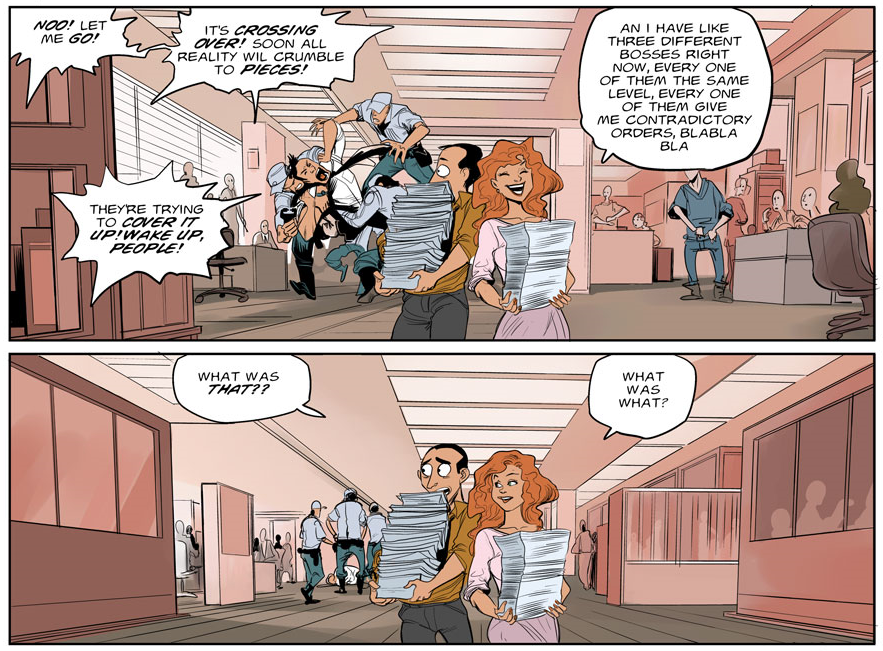
The ubiquitous ads so closely resemble real-world destruction that sometimes it can be difficult to discern one from the other... or at least, that’s what everyone is expected to believe. People see ads for things that they experience in their heads, and that is to be expected. It gets weird when people see things in their heads that later show up in “ads.” Drew’s dreams take on corporeal form, causing some serious damage. He doesn’t understand what’s going on, but something is clearly wrong, and no one will acknowledge what to him is plain fact. He has no credibility and no one to turn to.


Roughly half of Power Nap deals with technological and social change, with a focus on those who are marginalized by the system. The other half is mostly concerned with dreams. The two are connected in intricate ways, but those connections only become clear with time and reflection.


At its heart, Power Nap is the story of a man at odds with the world. The battlefield for this conflict is the dreamscape. Drew shouldn’t be dreaming at all; sleep should have been eliminated entirely. Drew’s anomaly is tolerated but not welcomed. Dreaming is an act of defiance in itself. The dreams break into reality, setting Drew further at odds with the authorities who refuse to acknowledge what’s happening.

Even discussions of his dreams turn into conflicts. Just like in other conversations, no one seems able to grasp anything beyond the most obvious surface references. The cultural reference pool has become small enough to be useless, particularly when discussing a deep and complex issue such as a person’s subconscious.


Then his employer starts having him work while dreaming, and conflict enters his dreamscape more directly. Not only does he have teammates and higher ups to argue with, but together they have to face down terrifying manifestations of some psychological hangup or another.


The technological leap from in-brain media to shared dreaming is easy to comprehend. There seems to be more at work here, but Drew’s employers won’t tell him anything, his in-dream teammates don’t yet trust him (or, likely, each other), and his real-world colleagues don’t know anything.

Drew might seem stuck, but: He is desperate, and he has nothing to lose. People in that position can do things that would never have occurred to anyone else. The powers that be may just find themselves shocked at what Drew comes up with.

That is, of course, assuming he has the energy to pull anything off.


In a lot of ways Power Nap reminds me of the movie Brazil. One man against the world, less concerned with social issues than with his own petty problems, with dreams playing an important role. If you like Brazil then you might enjoy these same qualities in Power Nap. If you don’t like Brazil, don’t worry, because Power Nap feels totally different. The tone, the personality of the main character, and the style of the oppressive bureaucracy are all distinct.

Power Nap definitely has a feel all its own. It strikes a good balance between action and intellect, and while the events depicted are often unpleasant for the characters, they are invariably fun for the reader.


Power Nap is written by Maritza Campos and drawn by Bachan. It updates irregularly; I’d recommend stopping by the website every month or so to see what's new or keeping up with Twitter or RSS.


Tuesday, June 25, 2013

Webcomic Worth Wreading, Entry Ten: Scenes From a Multiverse

Assume the universe is infinite. Eventually, given all of time and all of space, every conceivable thing that could happen, will happen. If you could travel instantaneously from place to place, you could then bear witness to events that are amusing, heartwarming, that seem to parallel events from our own experience or that simply appear completely absurd. To get an idea of what that experience might be like, you could start by reading Scenes From a Multiverse.


Scenes From a Multiverse provides satire, parody, highbrow and lowbrow humor, poignant reflections on humanity... anything and everything is on the table. Sometimes it’s wordy and complicated, and sometimes it’s just bunnies.


Technically speaking the strips all take place in continuity with one another, but typically each one exists in isolation. Every new comic is an opportunity to see a new, previously unexplored corner of existence. Occasionally a setting will appear multiple times, and sometimes a story will develop over multiple installments, but the essence of Scenes From a Multiverse is the continual introduction of the new and unexpected.


When Scenes From a Multiverse launched, a poll once a week determined which of that week’s locations would return in another installment. The mechanics of that process underwent some early permutations, and the practice has now been discontinued. If you read through the archive from the beginning, you will notice some changes over time in terms of the frequency and nature of the locations that see repeat visits.

There do seem to be a few constants in the multiverse. The Corn God is the deity of choice in most places, with occasional competition from Ultragod. People who do experiments are called Sciencemasters, though the level of respect and funding they receive varies. Most households get the latest news updates for their sector straight from the bill of Duck Thompson.

Remember that whole "Barack Obama is a chair" thing? MAN, reality is weird.

Current events and controversy, particularly that regarding politics and/or religion, provide frequent subject matter. Using a science fiction lens to look at our own world from a fresh and revelatory perspective is a tried and true form of social commentary.(This strategy can be seen in works as old as Gulliver's Travels.) You’ll typically find some sort of twist on the expected message. The more reasonable party might embrace a clearly ridiculous idea, or the straw man might turn out to have significant justification. Sensible ideas are subjected to reductio ad absurdum, and crazy ideas are treated with utmost respect and sincerity. The tone varies from one comic to the next, from one corner of the multiverse to another, from one joke to the following plea for reason.


Part of the fun is seeing new and interesting alien designs from one installment to the next. Sometimes they are color-swapped humans, sometimes they are elaborate creatures, and sometimes they are simple oblong blobs. Whatever form of being is the focus of the moment, it’s always enjoyable to see what’s being offered and to wonder what we’re going to see next.


There are lots of intense, conceptually intriguing installments that make points about life or philosophy, and those are wonderful. But there are also simpler entertainments. “Variety” is the key word for Scenes From a Multiverse. Some days you get a lesson about the public perception of atheism, and some days you get a fart joke. When the comic isn’t about a message it feels quieter and more low-key, but it still carries a sense of commitment and passion.
Some of the jokes that have made me laugh the hardest are those with the simplest concepts.

I actually think the punchline is the least funny part of this.

I guess I have a weak spot for miscommunication. In addition to the failed conversation above, another comic that made me laugh to no end concerns misheard lyrics to “Get Back.”


If miscommunication is funny on its own, when you combine it with satire you get a veritable powerhouse. After all, political discussions consist almost entirely of both sides actively refusing to listen to what the other side is actually saying. What you wind up with then is willful miscommunication. If you already think you know what the opposition is saying, there’s no point bothering to listen.


Be prepared for sarcasm, silliness, and cynicism. These qualities are broken apart and recombined in a multitude of permutations, and every time I see something new I’m excited to read it. Depending on the mood of the day, Scenes From a Multiverse might express hopes, fears, or merely a skewering of the status quo.

I'm going to take a moment here to tell you how much I friggin' love Empress Mrs. Spelt.


So! What we have here is a gag-a-day comic with new characters and locations appearing in almost every installment. The throughline that keeps them connected is a shared sensibility and visual style that keeps everything engaging and entertaining. There will always be something new to see, and that means I will always look forward to seeing it.
Scenes From a Multiverse is written and drawn by Jonathan Rosenberg and currently updates on Mondays, Wednesdays, and Fridays, though updates do not always go up on schedule.


Oh, and take note: There is mouseover text on all of these strips. (You have to go the comic website to see it, I didn't copy it over to the blog.) Don't miss out, read it all!

Previous Entry: Gunnerkrigg Court

Tuesday, June 18, 2013

Webcomic Worth Wreading, Entry Nine: Gunnerkrigg Court

The traditional role of science is to explain how the world works. By contrast, the traditional role of mythology is to explain why the world works. Technology is what you get when you use science to create practical tools, and magic is what you get when you do the same with mythology. The intersection of the two, the unease with which magic and technology coexist and the amazing things that they can achieve together, is the backbone of Gunnerkrigg Court.


Gunnerkrigg Court, the location, serves as a school... and much more. Antimony Carver, the focal character, is a student at Gunnerkrigg Court, and as she learns more about the history and technomagical nature of the Court, so does the reader.


Note: Gunnerkrigg Court is heavily story-driven. I wouldn’t be able to do this review without spoiling a few things, but I won’t describe specific plot points, and I’ll keep any strong spoilers confined to material that’s revealed early in the comic. A major source of tension in this story is the slow reveal of information, both to characters and to the audience. Out of respect for that, certain parts of this post will be a bit on the vague side.

While the institution of Gunnerkrigg Court claims to focus exclusively on science, mystical and/or magical things are commonplace within the complex. Antimony encounters mythological figures there on a regular basis. Then again, she seems to have encountered them frequently before coming to the Court as well.


The fantasy elements of Gunnerkrigg Court mix together with and complement the science fiction elements. The school certainly lives up to its technological dreams. For one thing, they have what is effectively a working holodeck at their disposal.


For another, the Court is absolutely full of robots.


The plot of Gunnerkrigg Court is complex and nuanced. Characters develop strong, believable relationships, and there’s a deep history to them and their environment. An idiosyncratic style to the writing keeps the sense of humor intact as the tone undulates from fun and humorous to intense and serious. The humor is extremely important to the comic, considering that much of the subject matter could contribute to a dour tone. As harsh as some events can be, there is always something silly and enjoyable to lighten the mood.


After all, it’s hard to let sad developments get you down when you remember there are such things as laser cows.


Gunnerkrigg Court is a comic of dichotomies. The dichotomy in tone between fun and serious story beats fits in alongside the dichotomy between science and magic. Characters’ relationships typically express some sort of dichotomy as well. Antimony’s best friend is Kat. While Antimony can intuitively manage mystical situations, Kat can intuitively manage technology and science.


The visual style is versatile, and often changes to the art will represent changes in the narrative or the perception of characters. When the things we are shown are outside the physical realm, panel boundaries might disappear entirely as everything takes on a connected, flowing quality.


Speaking of things outside the physical realm, mythical beings show up from a variety of traditions. Gunnerkrigg Court features a melting pot of gods and other figures from all over the world. Naturally, there is typically more to these characters than is clear from their initial appearances.


One thing I enjoy about reading Gunnerkrigg Court is being introduced to figures from mythological traditions I was unfamiliar with. Well known figures like the Minotaur show up, but more obscure characters such as Muut or the Moddey Dhoo make frequent appearances. Just as Lackadaisy or Luther Levy often teach me about history, Gunnerkrigg Court often teaches me about mythology.


Overall, Gunnerkrigg Court offers compelling storylines and character development in a fleshed-out sci-fi-fantasy setting. Though many elements of the story are familiar, they’ve been put together in a novel and engaging manner, and the comic is full of delightful surprises. From the big mysteries such as Antimony’s family history, to the little details such as the merostomatazon Court employees, there is always more to uncover.


Gunnerkrigg Court is written and drawn by Tom Siddell and updates on Mondays, Wednesdays and Fridays. It’s a good comic for kids, though some of the situations in the comic could be a bit frightening for young children, so I might recommend waiting until they’re 10 years old or so, depending on the kid in question.


Tuesday, June 11, 2013

Webcomic Worth Wreading, Entry Eight: Dresden Codak

We are always looking to understand more about our universe. For all the questions we've answered, there are always new ones to ask. Humans are very good at developing explanations for the things that puzzle us. Some of our explanations are founded in evidence, and these are the ones we trust. But there are times when evidence is scarce or difficult to gather, or when the question we are trying to answer is so new that we haven’t figured out what to do with it yet. This edge of human knowledge, where we don’t fully understand something but we think we know what questions we should be asking, is where you can find the subject matter in Dresden Codak.


Dresden Codak is often science fictional, frequently philosophical, and always surreal. There are two types of Dresden Codak comics: standalones and storyline comics. The standalones don’t necessarily have any continuity with anything else, but they sometimes include characters that also appear in the storyline comics, and in those cases you can typically assume that they take place in the same continuity.

Regardless of whether a particular installment is part of a storyline or not, it will typically feature compelling ideas coupled with absurd humor.


I’ll note here that, while there are storylines and there is continuity, I won’t be overly concerned with spoilers in this post. The events in Dresden Codak are not the point... It’s all about the ideas being presented and the impact of those ideas. The events themselves matter less than their context, and context is much more difficult to spoil.

Dresden Codak deals with an extremely diverse range of subjects, and it tackles those subjects in equally diverse ways. Sometimes there are engaging illustrations of theories that are fun to think about despite (or perhaps because of) their complete disregard for established scientific knowledge.


That same tendency shows up in a different form with “Caveman Science Fiction,” applying a modern fear of the unknown to ancient technological advancement.


Every Dresden Codak comic addresses some idea about the nature of reality. Sometimes those ideas are dealt with in a serious and thought-provoking manner, and sometimes they’re dealt with in a facetious and thought-provoking manner. What connects them all is an absurdist streak and an enthusiasm for asking the hard questions and exploring whatever answers come our way.


Some installments thoroughly explore a single concept, allowing enough atmosphere and pacing to let the central idea breathe.


Other installments cram so many concepts into one package that it seems as if it might burst, spewing bits of idea all over everything and ruining the carpet.


Last week I praised the striking composition that can be found in Family Man. At the risk of sounding repetitive, Dresden Codak often has truly innovative composition. Even in the most straightforward grid layouts, every bit of space is put to use, and often the flow of action goes in unexpected directions. For example, take this development in "Dungeons and Discourse," the Dresden Codak roleplaying game of choice. In the space of a single panel, events curve around a barrier and reverse direction.

Begin at the top and to the right.

Difficult questions about the future, dependence on technology, and the nature of humanity provide frequent subject matter. While developments in Dresden Codak are rarely reassuring, they are typically refreshing. There may be a cynical viewpoint at work, but it’s tempered with a sense of humor and humility.


I say “humility” because I feel that nothing expressed in Dresden Codak is definitive. The world may be depicted as cruel, but the world may turn out to be kind. Some installments seem to promote messages contrary to other installments. These messages are all worth hearing, but none are to be blindly accepted. They are suggestions, not statements.


And the overall message is one of enthusiasm for ideas and progress, and one of hope for the future. Even if we must temper our expectations with what we know of human nature, Dresden Codak encourages us to enjoy what we see when we look ahead.


Dresden Codak is written and drawn by Aaron Diaz and updates irregularly, with a new page typically appearing every few months or so.

The storyline currently running at Dresden Codak is called “Dark Science,” and the first page of “Dark Science” is possibly my favorite page in all of Dresden Codak. It made me laugh harder than practically anything I have ever read.