Tuesday, October 29, 2013

Webcomic Worth Wreading, Entry 26: I Do Not Have an Eating Disorder

You probably know more people who suffer from mental illness than you realize. People rarely discuss their mental issues in casual company. It’s a sensitive subject, something usually kept private. Being open about one’s own mental issues means being open to uncomfortable scrutiny and judgement. Too many people don’t even seek treatment for mental illness because of societal pressures to be “normal” and deny any aspect of themselves that does not live up to the standard of normalcy. Given this social milieu of denial and suppression, it’s wonderfully refreshing to find a comic like I Do Not Have an Eating Disorder.


I Do Not Have an Eating Disorder is a journal comic about a woman’s struggle with anorexia. Eating disorders are particularly prone to social stigmatization, and are closely linked with issues of identity, self-perception, and social perception. The reluctance to talk about personal experience with these issues results in a negative feedback loop whereby people become more reluctant to talk about their experiences or to even admit their experiences to themselves. The title of this comic is an outright denial of the comic’s subject matter, reflecting the author’s difficulty in coming to accept the truth of her condition.


This is a story that is rarely told, since few who’ve gone through these kind of experiences want to talk about it. Relating painful memories is difficult, so for that reason, along with fear of judgement, most people remain silent. I’m extremely grateful to have this comic available, providing a brave and thorough exploration of what it’s like to go through the process of identifying a problem and starting recovery.


I can see a lot of myself in this comic, even though I’ve never had an eating disorder. Unhealthy coping mechanisms for stress and depression are things that I do have experience with, and they’re not things that people really talk about all that often. Again, the social stigma of admitting that one is dealing with these problems prevents people from realizing how common these problems are. I Do Not Have an Eating Disorder can be a comforting read, from that perspective. Here is a person with problems who feels alone for having problems. I‘m willing to bet that even mentally and emotionally healthy people feel this way sometimes, and I think that the more open we are as a culture to talking about inner turmoil, as painful as it may be, the easier we will all find it to deal with these problems openly and honestly.


I Do Not Have an Eating Disorder is raw and honest. There’s a lot of inconsistency as the comic progresses, because the author is still processing her experience and recovering. At the beginning, certain things are only subtly alluded to, and as time goes by those things are directly addressed. Later pages sometimes reflect on attitudes from earlier pages and how the author has changed in the meantime. It’s a fascinating glimpse into a mind as it adjusts to new understanding and new practices.


There’s a lot in I Do Not Have an Eating Disorder about assumptions, the kind that people make about what is normal/abnormal, about what kinds of things are healthy or what sources of information are reliable. Even assumptions about our own abilities of perception can be dangerous, and the author has to unlearn a lot of things over the course of her journey.

Some people do lose their appetites when stressed. Some people eat more! Humans are variable and weird.

One of the biggest challenges in this comic is fear. Fear prevented the author from receiving treatment for a long time. Fear made recovery more difficult. Fear led to a lot of the problems she’s had to deal with in the first place. There’s even a great deal of fear regarding the creation and sharing of the comic itself. In a way, I view I Do Not Have an Eating Disorder as a triumph over fear. The author may still have difficulties, but the mere act of creating this comic about such a personal and emotionally loaded subject, and sharing that comic with the world, strikes me as a huge step forward. I am so glad that it is available for the rest of us to see.


I Do Not Have an Eating Disorder is written and drawn by Khale McHurst and typically updates with a new page over the weekend. Since it’s on Tumblr and doesn’t have a dedicated website, the archive can be a little tricky to navigate. Starting at the beginning and reading through is pretty easy, thanks to navigating links on each post, but the nature of Tumblr means that having a “latest page” button is pretty much out of the question. I tend to just bookmark the last page and then update the bookmark when a new page goes up, which is kind of labor-intensive, but, I think, worth it.

I recommend this comic to anyone who has ever had a problem that they were scared to bring up with other people. (If you think that description doesn't apply to you then I suspect you are lying to yourself.)


Tuesday, October 22, 2013

Service Interruption

Sorry folks, family stuff has come up and I haven't had the time or the Internet access to write about comics for you this week.

Thanks for your patience. I should have something for you next week.

Tuesday, October 15, 2013

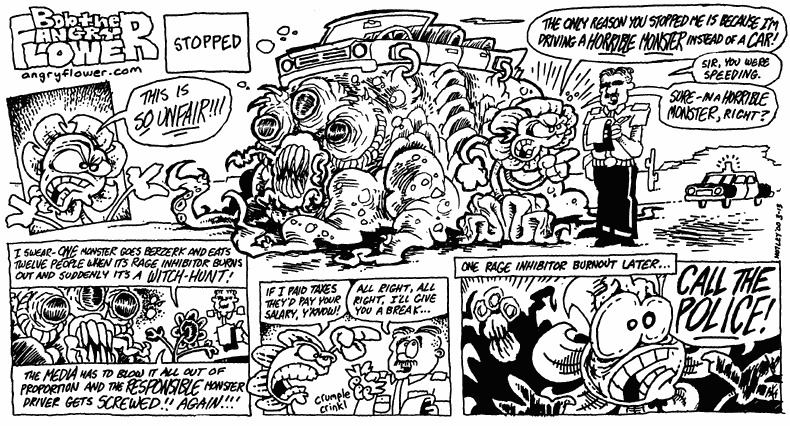
Webcomic Worth Wreading, Entry 25: Bob the Angry Flower

If you’d rather not read a short diatribe about terminology in regards to media forms, then you can skip the next two paragraphs and go right ahead to the first comic excerpt.

I was a little hesitant about this week’s entry, because I’m unsure whether Bob the Angry Flower counts as a webcomic. As far as I understand, it started in a print publication and has been in print publications for most if not all of its run. However, I encountered it first online, the entire archive is available online, and a reader can keep up with it without ever encountering the comic in print. My entire experience with Bob the Angry Flower has been as a webcomic.

Then again, the term “webcomic” is questionable. There are many who feel that specifying a comic as a “webcomic” is limiting in terms of audience outreach and that it creates a false barrier between old and new media. Obviously I am comfortable with the term, as I have used it in the title of this blog. Most of the comics I keep up with are webcomics, by which I mean “comics whose primary means of distribution is through the Internet.” I consider “webcomic” to be a useful category, though I can understand the objections I’ve heard. The purpose of this blog, though, is to celebrate webcomics, not to get bogged down in what makes a webcomic a webcomic. Therefore, I will continue as planned.


Bob the Angry Flower is a gag-based comic that relies primarily on absurdity and exaggeration. There is little or no continuity for the most part… Bob may die in one installment and show up as if nothing has happened in the next. While there are occasional references to things that happened in the past, some recurring characters and even the occasional multi-page story, one can usually read any given installment of Bob the Angry Flower without losing anything by not having read others.

As the title suggests, the comic focuses on Bob, a flower who is angry. Sometimes he’s angered by completely sensible things like political ineptitude or grave injustice. Sometimes he’s angry about silly things, minor inconveniences and such. Sometimes he’s angry about things that are entirely unreasonable, like how his plan to take over the world has been hampered because his robot army is insufficiently bloodthirsty.


Bob’s characterization is not necessarily consistent. At times he can be seen as a direct analogue for the author, reflecting his creator’s struggles and personal beliefs. However, he is often portrayed as monstrous, espousing viewpoints that no sensible person would ever take seriously and embracing values that are plainly abhorrent. He is rarely portrayed sympathetically.

Still, I find it hard not to love Bob, in the way that you love a great villain or a magnificent bastard. He’s emotionally volatile, violent, and abusive toward his friends. Bob is a horrible person, but I love him anyway. I love him the way I love Rimmer from Red Dwarf; his negative qualities somehow turn him into someone so much more compelling than admirable qualities could make him.


One could even argue that his inconsistencies are part of a larger thematic element, that Bob is fickle in thought and intention, so that he may be capable of perfect reason one day and behave entirely irrationally the next. He has been shown to make capricious and abrupt about-faces in his attitudes, so it’s conceivable that he lacks a strong self-identity and makes up for it by madly embracing whatever seems important or desirable at any given time.

Thus, Bob can serve as a metaphorical stand-in for either side of a conflict. He may be the hero or the villain, depending on the moment and the demands of the joke. He may speak with a sense of complete logic, or express the opposite of whatever a reasonable person would think. You never know quite which Bob you’re going to get.


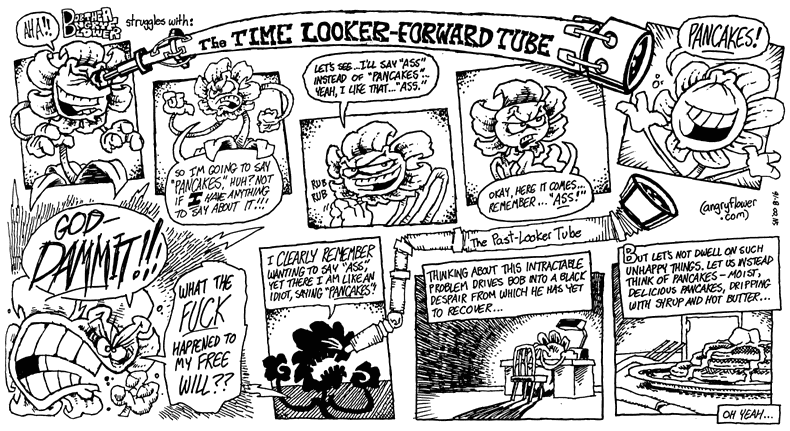
Occasionally the comic will do something interesting with the format. The title is almost always presented in a novel way, and the characters will express awareness of their medium and interact with the page elements from time to time. I’m particularly this one, which is a simple enough time-travel sort of joke but which calls into question all sorts of things about determinism and the nature of a comic as a fixed image and the relationship between that image and the flow of time and I just love it.


Sometimes the comic will contain suggestions that I find compelling, though they are presented as jokes and there is no real implication that any of them should be implemented. These ideas include eliminating apostrophes from our language entirely, since people can’t seem to use them correctly. My favorite of these is the idea that we should say “advanced” as an insult instead of “retarded.” I actually really hope that this one will catch on one day.


The setting of Bob the Angry Flower is versatile and bound by few rules. Just about anything can happen. Expect to have your expectations subverted, though whether by sudden robot attacks or by a seemingly deadly situation turning into a dull and uneventful afternoon at home, it’s hard to predict.

Things can get pretty weird, but then, the baseline in this comic is “talking flower getting worked up about stuff,” so weirdness should be expected. Science fiction and fantasy elements show up frequently, and so do things that are just surreal, or things that could happen in the real world but don’t just because no one would ever do that.


The versatility of the setting, combined with the absurd nature of the humor and the lack of continuity, allow for some brilliant non-sequiturs. When anything and everything could happen, sometimes the thing that does happen is so bizarre it makes a kind of poetry.


When you read Bob the Angry Flower, you’ll see unexpected images, some of them beautifully grotesque, and many of them unadulteratedly amusing. There’s love, loss, rage, power, war, acceptance, philosophy, and a deep appreciation for scientific advancement. One of Bob’s few constants is that he places himself firmly in the intellectual elite, so depending on your outlook, there are times when you may identify with him ( such as when he rails against incorrect apostrophes) or think he’s being comically overreactive (such as when he rails against incorrect apostrophes).

Whether you can identify with Bob or not, though, one will always understand his nature, and his nature is that of an asshole.


If you read through the archive, (again, you don’t have to in order to understand the comic, but it’s there and it’s full of this comic that I love and will gladly read over and over) you’ll probably notice that the resolution on a lot of the early comics is fairly poor. They are legible but it can take some time to work out the writing. There’s also an annotation section on the website, which gives some pretty fun insight into a lot of the earlier comics.

Aside from the home page, the archive, and the annotations, most of the website is pretty out of date. Luckily, that’s not stuff you need in order to read and enjoy the comic, so don’t worry about it. I did find a few broken links in the archive, so again, if you come across those, don’t worry and just skip on to the next comic. Try not to think about what you’re missing out on.


Bob the Angry Flower is written and drawn by Stephen Notley and updates on Fridays. I recommend it for people who can get a little worked up over silly issues, and who are comfortable recognizing this part of themselves and laughing at it.


Tuesday, October 8, 2013

Webcomic Worth Wreading, Entry 24: Oglaf

I’m putting this week’s entry behind a cut, because the comic under discussion contains a great deal of adult content, and some adult content is excerpted in this post. If you are over 18 and comfortable viewing explicit drawings of sex, then click through. If you are not both of those things, then come back next week, when this blog will be dealing with a comic that is far less likely to offend delicate sensibilities.


Tuesday, October 1, 2013

Webcomic Worth Wreading, Entry 23: Diesel Sweeties

Suppose you know someone who is the living embodiment of a stereotype. That person is, unsurprisingly, wrapped up in any number of personal issues, to the extent of being nonfunctional. Suppose everyone else you know is that same level of difficult and emotionally handicapped. Suppose that some of these people are sentient robots. This is the cast of Diesel Sweeties.


Diesel Sweeties is a gag-a-day comic about some robots, some humans, and the complex web of feelings that connects them all. There is continuity, and there are some long-running storylines, but for the most part each installment stands on its own. There are only a handful of developments I wouldn’t want spoiled if I were reading it for the first time, so I won’t mention any of them here. For the most part, though, worrying about spoilers is irrelevant to the enjoyment of this comic.

The characters are each their own unique bundle of messed-up. The general madness of the Diesel Sweeties population comes through subtly at first, then insinuates itself until it begins to feel normal. When the baseline is so far away as to be invisible, it’s easy to forget that there is a baseline at all. Then eventually you’re friends with (or even sleeping with) a murderous machine with the stated goal of crushing all humans, and it doesn’t really strike you as something to be questioned.

Please note that Red Robot #C-63 is an outlier, and most robots are not this violent.

Most of the cast can seem two-dimensional at first, but over time, as we get to see more aspects of their personalities, they become quite well-developed. They still behave in ways that seem ridiculous, but one can see how this behavior originates in their personal issues and dysfunctional relationships with one another. Read enough Diesel Sweeties, and you could witness the deconstruction of a stereotype by the development of a believable character with all the necessary mental hang-ups to express that stereotype fully.

All that happens gradually and in the background, though. The focus, from strip to strip, is on the jokes. Only in looking at the combined weight and shifts in self-awareness of the characters over time and over hundreds of punchlines does a pattern start to shine through. Each installment, taken on its own merits, delivers a joke that is easy to understand on its own and does not require the weight of all other Diesel Sweeties content to make an impact. Even when the characters do act off-kilter, it can come off as an attempt at being ironic or just putting on an act for the sake of snarking around with the other characters.

Noting the deeper internal struggles of each character and the development of such struggles over time is just an added bonus.


These characters love joking with each other, even if their senses of humor don’t always align. They take delight in anticipating others’ double entendres (see the first comic example in this post) and in one-upping another’s punchline. Humor is probably the most important element to disguising each character’s dysfunctionality. Exaggerated character traits are played up for laughs, and it takes a while to realize how deeply ingrained they actually are.


The misleading lack of depth that characters seem to have upon initial viewing is prevalent in their names. Even when characters have established full names, some character names remain nicknames that impose a simplistic label upon them. Indie Rock Pete and Metal Steve are rarely referred to without their epithets, and Lil’ Sis is always Lil’ Sis even when her older sister is nowhere to be seen. (Lil’ Sis is not a stereotype, but a label implying that the character’s relevance is only in her relationship to another character, when Lil’ Sis is an established character in her own right with her own personality and her own relationships to the other characters.)

The Diesel Sweeties format is simple yet versatile. When the format is shaken up in some way, it is often subtle but usually rewarding to those who notice. Color changes in the background may correspond to the mood of the characters, the implication of a joke, or may work together to paint a larger picture. Keep an eye out as you read.

On a less fundamental scale, the format of the jokes and typical dialogue patterns of the comic is emphasized and poked fun at on occasion, such as when the characters cease talking as they normally would and start fitting themselves into the format of other media.


Much of the comic is concerned with sex--it’s prevalent not only in characters’ discussions and interactions, but also, in some cases, their careers. One of the main characters is a sometimes-retired porn star, with all the dignity and maturity that entails (read: none at all). (This is not a dig at real-life porn stars, about whom I know nothing and cannot afford to make assumptions.)

The general dysfunction that applies to the rest of the characters’ lives is still in effect when it comes to sexual matters. They usually can’t resist the chance to make a joke rather than having an honest discussion, and the jokes themselves often wrap up an uncomfortable truth in disguise as a punchline.


One of my favorite parts of Diesel Sweeties is seeing the characters get all dressed up for Halloween every year. We get to see some fun costume designs, some insight into the characters based on their costume choices, and some jokes that couldn’t be told outside the context of Halloween. And today is the first day of October, so Halloween is quite a bit on my mind just now.

Astute readers may recognize the costume in this comic.

For a while, Diesel Sweeties was syndicated and available in the form of a newspaper comic strip. The newspaper version ran concurrently with the web version, and while it wasn’t running in any newspapers near me, I kept track of it at comics.com (which is now gocomics.com), the place to read newspaper comics without buying a newspaper. That online archive is no longer available, but those comics are currently being put up at the Diesel Sweeties website, one week at a time. If you enjoy reading Diesel Sweeties, then the syndicated version offers you more Diesel Sweeties to read!


With Diesel Sweeties, you get a lot of jokes, a lot of irony and pretension, and if you look closely enough, some insight into what those things mean about a person, or even about society at large. These characters operate by their own rules, and it’s fun to look into a setting where the standards of behavior are so particular. Above all, Diesel Sweeties is a reliable place to find something new to laugh at on a regular basis.


Diesel Sweeties is written and drawn by Richard Stevens III, and updates on Mondays through Fridays. I recommend it to people who like to read comics ironically.

Note that, after a certain point in the archive, each installment has a title. This title is visible in the browser tab, or as mouseover text. After a certain later point, the titles are present as part of the comic image. Reading the titles is not necessary to appreciating the comic, but they usually add a little something.


Next Entry: Oglaf (Warning: NSFW)

Tuesday, September 24, 2013

Webcomic Worth Wreading, Entry 22: Girls with Slingshots

“Relationships” is the watchword of the day. Romantic and sexual relationships, certainly (with all the similar and distinct connotations of the two), but also abiding friendships, relationships with acquaintances and family members, and even relationships with pets and houseplants. The people we care about, whether we love them or loathe them, help to define us, and hopefully to make us better people. One can find all manner of strong relationships just by taking a glance at Girls with Slingshots.


Girls with Slingshots is a gag-based comic centered around the unlikely, but deep and unshakeable, friendship between two women who are as different as they could possibly be. They represent physical extremes as well as emotional extremes, Jamie providing the optimism and enthusiasm, Hazel providing the cynicism and reluctance. Just about the only things they share are a love of booze and talking about boys, which has proved to be enough for them to maintain their bond throughout the years.


Note: Girls with Slingshots is a gag-based comic, but it does have continuity and some significant long-running storylines. (The above strip is NOT a spoiler, so don’t worry about that.) I won’t discuss plot points in detail here, but certain developments, particularly those which occurred in the early years of the comic’s run, would be hard to disguise entirely. If you’d rather read the whole comic fresh, I suggest you start at the beginning right now. If you’re comfortable with knowing a few things in advance as you go into it, or if you need a little convincing before jumping in, then proceed at will. If you want to read the comic, I recommend going through the whole archive just to have a grasp of who the characters are and where they come from, but if you’re okay with being a little out of the loop, most of the jokes are still funny even if you don’t know the entire backstory.

Most of the characters seem to spend most of their time concerned with sex. If that subject makes you squeamish, I actually recommend reading Girls with Slingshots all the more, because it’s fun and silly and perhaps a good way to step outside your comfort zone. If the subject of sex does not make you squeamish, if you in fact enjoy reading dick jokes and/or sexual drama, then you will find a lot to love in this comic.

This example is actually pretty tame but SO FUNNY.

The characters represent a wide variety of viewpoints on sex, relationships, and each other. They come from different backgrounds, and have all sorts of preferences, both in regards to the sex of their partners and the types of relationships they have. Functional and dysfunctional relationships, long-lasting partnerships and casual flings, people who meet over the internet or by hanging out in bars or maybe by discovering shared taste in books at the library, there’s a wide range of human experience, and that range is reflected in the relationships you’ll see in Girls with Slingshots.

There's quite a diverse representation of relationships, showing us a wide variety of attitudes toward heterosexual relationships and lesbian relationships. The only thing that's missing is a selection of male homosexual relationships. There's one gay man who's a significant character, and is emphatically not representative of all gay men. Then again, no one person can or should represent their group as a whole, nor can a selection of people, however diverse, provide a full picture of the range of attitudes that belong to a particular group.


One thing that I really appreciate about Girls with Slingshots that I haven’t seen elsewhere is a fantastic portrayal of an asexual. Erin is friendly, enthusiastic, and an excellent role model for anyone who feels that they might fit in with an asexual identity. (Please note that the following strip does constitute a spoiler, so only read on if you’re willing to have certain outcomes taken as granted when you get to the Jamie-trying-to-find-love storyline stuff.)


Representations of asexuals are almost entirely absent from most media, so it’s really nice to see a character who identifies as asexual and who is still fun and relatable. She’s also just, like, super cute, and I want to turn off the fourth wall for a hug as much as she does.

Sometimes fictional people answer questions from real ones! It's pretty great.

You can assume that the world of Girls with Slingshots works like our own, unless noted. Most of the humor is based on regular human foibles and mishaps that could happen to anyone, and most of the drama is the kind that people go through in real life… Issues such as someone’s girlfriend and best friend really not getting along, or how to handle dating a deaf woman if you’re only just learning sign language (as seen above). There are a few fantastical elements, though. Most prevalently, cactuses (and other houseplants, sometimes) possess powers of speech and mobility. Nobody ever expects the cactus to talk, at first, but over time they all seem to get used to it, and McPedro the talking cactus develops into an important character.

Oh, and there are ghosts sometimes too.

And even if they’re not answering reader questions, the characters still express an awareness of their medium. This type of explicit acknowledgement that they are characters in a comic is used sparingly but effectively, allowing characters to more fully express themselves to the reader by utilizing all available tools. Playing with the format actually makes the world of the characters seem more, not less, real. These people know what they are and what kind of medium they inhabit and they’re not afraid to make use of it when it suits them.


It’s also nice to see a comic featuring so many women, with so many different body types. There are the obvious extremes in Hazel and Jamie, who are beautiful in completely different ways, but just about every woman in this comic would be visually distinct from every other woman just by their silhouettes. Any time I worry about the portrayal of women in comics, when there are so many identical-looking women with huge hips and breasts and ridiculously thin waists, my go-to counterexample is Girls with Slingshots. It’s far from the only webcomic that features well-rendered examples of a variety of female figures, but I think it’s one of the clearest examples of how to draw women well.


In a comic that’s so concerned with sex, that most common source of tension, there’s a surprising lack of reliance on traditional sexual stereotypes. The characters are so well-developed and nuanced that even when they are being stereotypical (which happens less often as the comic goes on) they feel fresh and honest, true to some inner self. One advantage these people have is that they’re comfortable with themselves and with each other, so that they can just acknowledge their feelings rather than expressing concern over whatever they think they should feel.

The old “sensitive man, insensitive woman” turnabout has been done so often that it doesn’t actually count as subversive now. But the relationships in Girls with Slingshots are more complicated than that, more authentic, more varied. Men and women want different things, to be sure, but really, each man and each woman want different things, and sometimes they make assumptions and sometimes those assumptions get them in trouble and sometimes it’s embarrassing for everyone involved but sometimes it works out really well and everyone’s open and honest and they all get along super well.

I mean, not most of the time. Most of the time there’s misunderstanding and conflict and hurt feelings even though everybody’s doing the best they can. But sometimes… sometimes, it all seems to work out.


Central to the comic, among all these relationships and conflicts and desires, the heart of the story is still Hazel and Jamie’s friendship. They care about each other more than anything, and they usually express this care in unorthodox and inimitable ways. No one could consistently put up such a consistent act of devotion, with all the subtle touches involved, without holding the other person deep in their heart.


I realize I’ve been talking up the deeper thematic aspects of Girls with Slingshots, because those are what stick with me the most after years of reading. The initial appeal, though, is in the humor. Girls with Slingshots is funny as hell, with a whole lot of silliness and some very well-executed punchlines. That’s what first drew me in as I read it, and then as I became more familiar with these people and their world, I found myself falling in love with the characters and just wanting to spend time with them, and see how they’re doing and hope that they can take care of themselves. (These people are sometimes not that great at taking care of themselves.) There’s an excellent balance here between instant-gratification-sating laughs and deeper, long-term emotional fulfillment.


Girls with Slingshots is frank, funny, and pulls off that extraordinary combination of hopefulness and cynicism that I find so compelling.

So! Come for the crude jokes, stay for the complex emotional drama. I don’t think you’ll be disappointed by either.


Girls with Slingshots is written and drawn by Danielle Corsetto and updates Mondays through Fridays. There’s mouseover text on strips from here on. I recommend it for people who like laughter and empathy.

Oh, and correct grammar.